



The creative process has become too self-conscious. Just look at what the moodboarding process has turned into. A photographer, art director, or interior designer once used a moodboard as a tool. In its purest form, you pinned images on a wall to help you find or define a direction for a project. Then the moodboard became part of the standard commercial workflow, where it was tasked with accomplishing more. Say you’re hired to shoot for a brand campaign. Before you can execute your idea, you need approval from your client, so you create a moodboard with your “proof of concept.” Now your moodboard has an agenda. It has to sell something.
This was the engine behind Pinterest, a place to find visual inspiration for just about any creative project. Pinterest was a resource to assist you in your creative process, but it was also a social platform. You curated, you pinned your inspiration to your various boards. Suddenly, we were all art directors creating a proof of concept for everything: our home, our outfits, our future wedding, our 26th birthday party. We browsed our feed and pinned our pins with an audience in mind; we knew it all said something to someone about our taste.
Now, it seems, taste is the end goal in itself. We’re no longer creating moodboards to fuel our creative work. The moodboards are our creative work. We bring our references into digital canvases and move images around, creating little universes on our screen, feeling as though we’ve made something. You see these complex boards and systems shared online, but you never see what actually comes from them. You see whimsical handmade moodboards all over Substack, and it seems they were made just for the sake of posting them. These moodboards are designed; they’re looking over their shoulder to see what you think of them.
The moodboard has become a performance. We’re spending more time conceptualizing the thing than actually creating the thing, overcomplicating our work and wasting our own time. The romanticization of the process, or what we can call “productive procrastination,” has turned what was once an intimate, private practice into something we’re sharing for the timeline. The moodboard has become a “pretty” artifact.
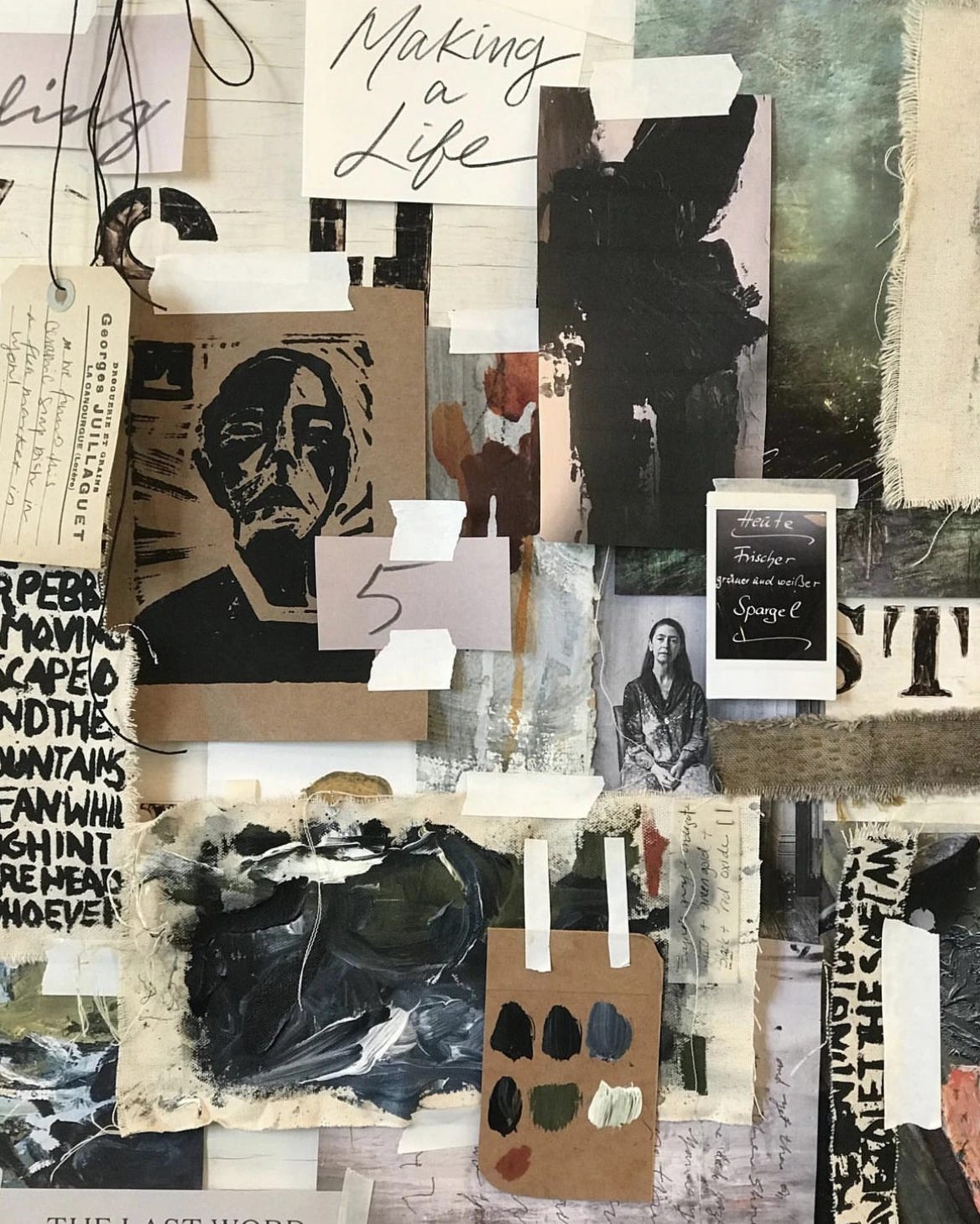
Do we even need the moodboard anymore? The Instagram algorithm is so dialed in, art directors, photographers, and designers have a steady drip of inspo straight to the brain at all times. If you’re going for a specific mood or referencing an existing concept, just pull a few images and call it done. Don’t overcomplicate it.
Creativity requires the mental freedom to like what we like, without worrying about how it looks, how pretty it is, whether it fits our goals, our grid, or our “second brain” folder system. The beauty of a moodboard, originally, was its unselfconscious randomness. A newspaper headline about a rescued dog next to a magazine clipping of a woman in a bathtub. A glass perfume bottle beside a dirty city bus. This randomness or serendipity was essential to the practice; the seemingly unrelated visuals and objects led us somewhere a carefully tuned algorithm couldn’t. Creative people throughout the ages have spoken about the power of randomness in their creative process, and the importance of finding connections between unrelated things. The magic is lost with too much self-awareness. The purest form of a moodboard is a kind of alchemy, where things break down into something new. This requires the mess, the happy accidents, the unplanned and unorthodox contrasts lighting up something in our brains.
The creative process doesn’t have to be a performance. It can just be what it is, a process. A means to an end. The new moodboard may be something less pretty, less public, less curated. It won’t be organized or easily identifiable to a client; it may not make sense even to ourselves. We can take the moodboard off its pedestal. It’s not a piece of art in itself.
I attribute the lack of real artistic products to the fear of rejection. If you can just create infinite mood boards with zero final product, you shield yourself from (very valuable) criticism that inhibits your creative process.